
4 September 2025 – The Korea–Indonesia Research Cooperation Center (KIORCC) convened the “Offshore and Energy Market Updates in the South Asia Region” webinar, gathering experts from Indonesia, Korea, and Singapore to exchange perspectives on natural gas, infrastructure development, and regulatory frameworks shaping the regional energy landscape.
The session opened with welcoming remarks from Mr. Cho Il-Hyung, Director of KIORCC, who expressed appreciation to the speakers and participants, emphasizing the importance of sharing business and legal opportunities while reassuring that current political conditions should not be seen as an obstacle. He highlighted that the session had been carefully prepared to provide meaningful insights for both industry and government stakeholders.
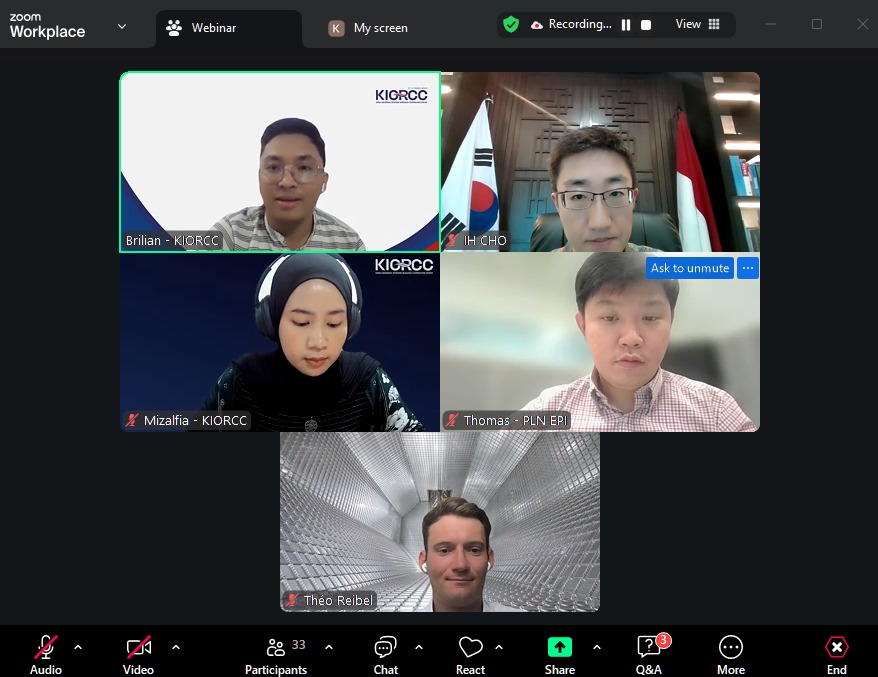
Discussions began with a presentation by Mr. Thomas of PLN Energi Primer Indonesia (PLN EPI), who outlined Indonesia’s roadmap for power supply and gas infrastructure. He highlighted PLN’s target of 69.2 GW total capacity, with gas and LNG positioned as central to meeting future demand. Plans include the development of new gas-fired plants and seven Floating Storage Regasification Units (FSRUs) in Java, Bali, and Sumatra, as well as onshore regasification projects. He explained that tenders for new infrastructure will be launched later this year and emphasized the need for strategic partners across technical, EPC, financial, and legal roles. He also noted that PLN intends to prioritize domestic LNG supply while adhering to ministerial formulas for gas pricing.

Attention then turned to the regulatory landscape, where Ms. Fia of KIORCC presented the third amendment of Indonesia’s Shipping Law No. 17/2008. The amendment reinforces cabotage principles, strengthens the domestic shipping industry, and sets new requirements for foreign investors. These include joint ventures with a maximum of 49 percent foreign ownership, the operation of Indonesian-flagged vessels of at least 50,000 GT, and the application of a grandfather clause for restructuring and new vessel acquisitions. She highlighted that the amendment reflects Indonesia’s intent to safeguard its maritime sector while balancing foreign participation, ensuring that new entrants contribute to domestic capabilities rather than bypassing them. In response to concerns raised during the discussion, she explained that while foreign investors are welcome, adherence to local requirements remains essential, with exceptions carefully defined to protect ongoing investments.
From the industry side, Mr. Theo of GTT Singapore shared insights into LNG shipping solutions supported by proprietary membrane technologies and more than six decades of expertise. He highlighted the advantages of LNG as a cost-effective and lower-emission alternative to coal, with FSRUs offering flexibility and scalability compared to onshore terminals. He also noted Indonesia’s growing importance as a hub for LNG development, supported by existing projects such as Lampung and Jawa 1. Addressing audience questions, he underlined the opportunities in operations and maintenance services, as well as new demand driven by data centers that will further reinforce LNG’s role as a bridging fuel in the transition to renewables.

The webinar concluded with a shared recognition of the critical role of natural gas in Indonesia’s energy transition, the urgency of integrated infrastructure development, and the growing potential for Indonesia–Korea collaboration in advancing offshore and LNG technologies. With contributions from PLN, KIORCC, and GTT Singapore, the session provided a comprehensive overview of business opportunities and regulatory frameworks shaping the region’s energy future.


